
What the Heck Is a Harold? (And How To Actually Do One)

What the Heck Is a Harold? (And How To Actually Do One)
In 1967, a San Francisco improv troupe called The Committee piled into a Volkswagen bus after performing a show at a high school in Concord, California. The subject of their performance? The Vietnam War.
On the drive home, someone asked: what should we call what we just did?
From the back of the van, a musician named Bill Mathieu shouted "Harold!" — a joke reference to a scene in A Hard Day's Night where a reporter asks George Harrison what he calls his haircut. George deadpans: "Arthur."
Del Close, the group's director and one of the most influential figures in improv history, later said he wished they'd picked a better name.
They didn't. The name stuck. And the Harold went on to change long-form improvisation forever.
If you've been performing improv or in improv classes in Portland or other cities for any amount of time, you’ve already heard the word "Harold" thrown around at festivals, jams, and workshops. Now, let’s cover where it came from, why it works, and how to actually do one.
THE HISTORY (THE SHORT VERSION)
The Harold began as a loose, exploratory form — more philosophy than structure — developed by Del Close during his time with The Committee. When the group disbanded in 1972, the Harold nearly disappeared with it.
It didn't.
In the early 1980s, Close joined Chicago's ImprovOlympic (now iO Theater), where he and co-founder Charna Halpern spent years codifying the form into what most people now recognize: a three-beat structure built around a single audience suggestion. In 1994, they published Truth in Comedy — the Harold's bible, and by extension, the bible of long-form improv itself. The book's central thesis was radical in its simplicity: the truth is funny. Not jokes. Not wackiness. Human truth.
In 1996, the Upright Citizens Brigade — Amy Poehler, Matt Besser, Ian Roberts, and Matt Walsh — brought the Harold to New York and gave it a more analytical, game-focused spin. Their influence spread the format further and faster than almost anything else in improv's history.
Today, the Harold is performed at theaters across the world. It's taught in virtually every serious long-form training program. One improv scholar described it as the "Latin" of the art form — the foundational language from which most other long-form formats descend.
WHERE I FIRST LEARNED IT
I first encountered the Harold & the La Ronde at The Empty Stage Theater in Los Angeles, studying with Stan Wells — one of the more important long-form improv teachers in the country, and a man whose influence on the field runs far deeper than most people realize. Stan developed his approach to long-form at The Groundlings Theater before building his own theater, The Empty Stage, where he worked with comedy stalwarts, Kristen Wiig, Conan O'Brien, Felicia Day, and Lisa Kudrow. His philosophies, and his distinctive Clap-In editing style, are at the foundation of how I teach long-form improv today at Change Through Play.
That lineage matters to me. And it's part of why I'm so passionate about introducing the Harold to students who might not know it yet.
WHY IT WORKS
Before we get to mechanics, it helps to understand the underlying idea — because the Harold is built on a counterintuitive premise.
Improvisers are not storytellers. They're pattern makers and pattern discoverers.
Del Close didn't want his performers engineering plots: he wanted them to follow the patterns that emerged organically from a single word. The Harold's structure creates the conditions for those patterns to surface — and then asks performers to trust them.
His "Teepee Metaphor" is still the clearest explanation I've encountered: the further apart the legs of a teepee are placed, the more weight the structure can hold. If your first three scenes are too similar in tone or context, the Harold collapses under its own redundancy. Distance creates tension. Tension creates connection. Connection creates the moments audiences remember.
The other core principle? Everything in the world is connected. Not as a spiritual claim (although, sure: that too) — but as a structural one. The Harold is designed to prove it, every single time.
HOW TO PLAY
A Harold typically runs 25–35 minutes and is played by four to eight performers. Here's what it looks like from the inside.
The Suggestion Ask the audience for a single word. Just one. That word is the seed of everything that follows. Many Harold teams start by announcing, “Give us a suggestion of anything!”
The Opening The whole ensemble takes the stage and begins exploring the suggestion — not literally, but associatively. This might look like a pattern game, a series of short monologues, sound and movement, or a deconstruction. The opening has three jobs: generate ideas, build group mind, and engage the audience. Don't rush it. Let things surface. Here’s an amazing example of a Harold opening:
First Beat — Find the Game Three, separate, two-person scenes emerge from the opening. They should be completely unrelated to each other, but each one should connect to at least one element from the opening. The key question at this stage: what's unusual here? The way a character thinks? Some word or phrase that was said? A physical gesture? Ask yourself: "If this unusual thing is true, then what else is true?" That question is the engine of the scene. It’s a shortcut to find the purpose of the scene or the game — and play it.
Group Game #1 The full ensemble comes back together for a group game — lively, full-company, a palate cleanser that marks the end of the first beat before the next layer begins.
Second Beat — Same Game, New Situation Each of the three scenes returns — but elevated. You're not just continuing the story. You're playing the same game in a new situation. This might mean taking characters to a different location, jumping forward in time, or finding an analogous scenario that heightens the core tension. Expand the world. Raise the stakes.
Group Game #2 Another full-ensemble moment. Another breath.
Third Beat — Connections and Callbacks This is where it all comes together — and where the Harold earns its reputation. The third beat is the shortest, the most heightened, and, when it lands, the most electric part of the form. Scenes merge. Characters collide. Themes converge.
Shown graphically, here’s what the full format looks like.
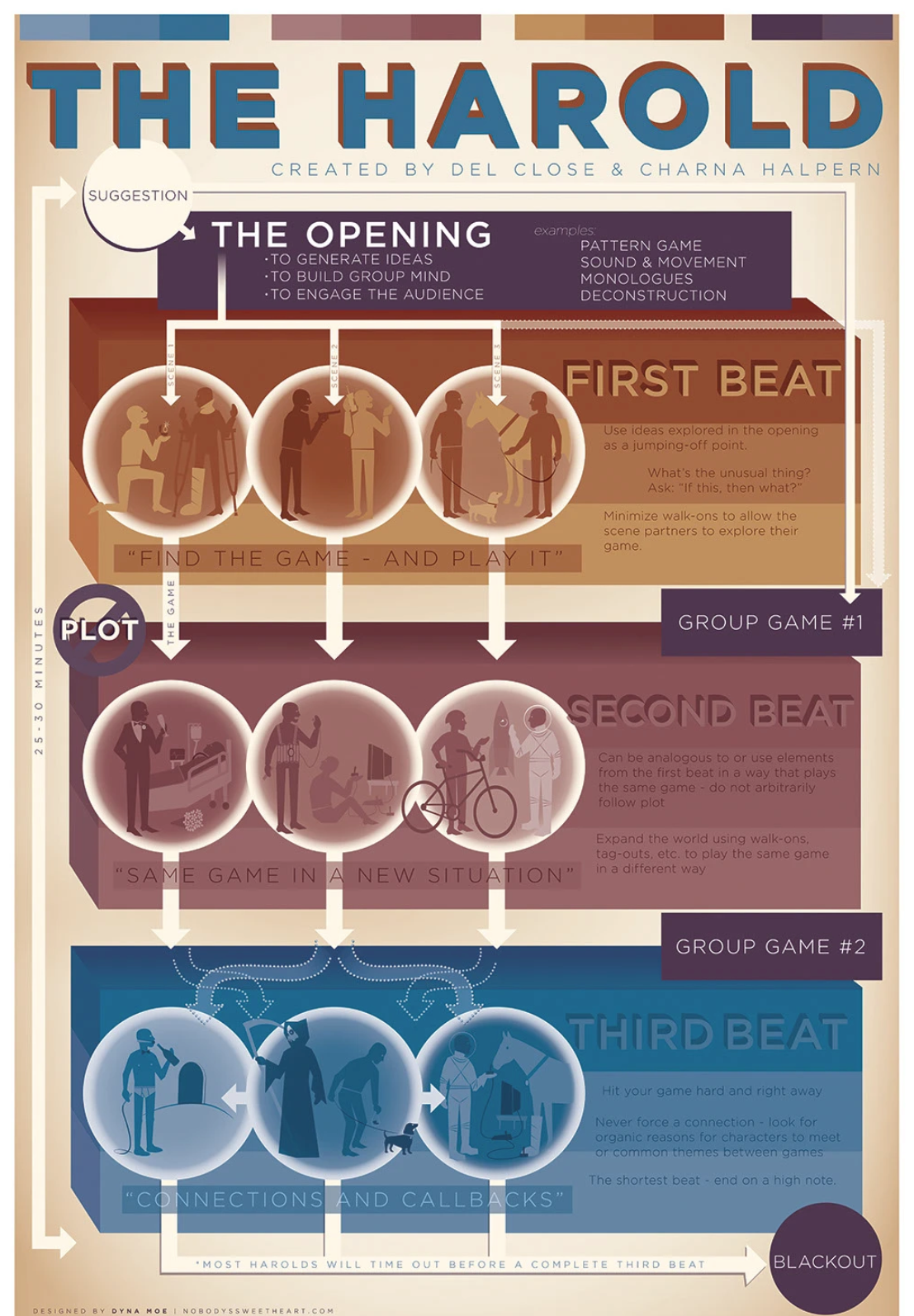
Graphic Credit: nobodyssweetheart.com
And here's the most important rule of the entire format: Never force a connection.
Look for organic reasons for characters to meet or themes to meld. The Harold should feel inevitable in retrospect, not engineered in the moment. Hit your game hard and right away. End on a high note. Then: blackout.
(A note: many Harolds will time out before a complete third beat. That's not a failure. The blackout is the signal that it's over — not the completion of a checklist.)
THE FIRST RULE IS: THERE ARE NO RULES
Del Close was explicit that the 3x3 structure was training wheels — not a cage. Once a group develops a feel for the Harold's rhythms and principles, departures aren't just allowed — they're expected. He wrote it himself in Truth in Comedy: "the first rule is: there are no rules."
The Harold doesn't ask you to follow a map. It asks you to trust your ensemble, follow the patterns, and believe — against all instinct and anxiety — that everything is connected.
It usually is. That's the whole point. Here’s an example of a full Harold from a team at UCB in 2025:
Ready to study the Harold yourself? Our intermediate and advanced students are in the middle of working through the format right now — rehearsing it, performing it, and discovering what it can do. If you want to study the Harold and other long-form formats with us, join our classes and get in the room.