
6 Things Every New Improviser Needs to Know
6 Things Every New Improviser Needs to Know
Before your first improv class — or your first free video lesson — here are the 6 core ideas that will change how you show up in every scene.
Most people walk into their first improv class carrying the same set of assumptions.
They think improv is about being funny. They think it requires quick thinking. They imagine they'll have to perform — really perform — in front of strangers and somehow be judged on whether they're "good" at it.
Almost none of that is true.
In 25+ years of improvising and teaching, I've watched brilliant, creative, genuinely fascinating people get in their own way in those first few classes — not because they lacked talent, but because what they thought improv was... wasn't improv.
So before you walk into your first class, here's what actually matters.
What do beginners actually need to learn in improv?
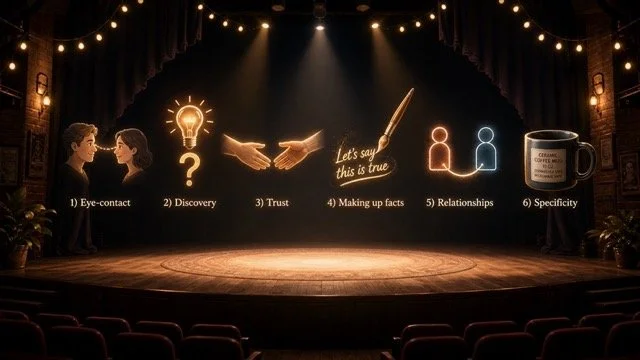
Six things. Not a list of rules or techniques — six core ideas that shift how you show up in every scene, every exercise, and every class.
1. Eye Contact Isn't What You Think It Is
Every new improviser gets the same note in their first week: make eye contact with your scene partner.
It sounds simple. It isn't.
What most people do with that note is lock eyes with their partner in a way that feels less like human connection and more like a staring contest. It's uncomfortable. It's unnatural. And paradoxically, it makes scenes feel less real, not more.
Here's the truth: selective eye contact — the kind we use in real life, where we look away to think, look down when we're embarrassed, glance sideways when we're confused — is far more believable than constant eye contact. You don't stare at people in real life. Don't stare at them on stage.
Be more selective. Watch what happens.
2. Planning Is the Enemy of Good Improv
Nobody tells beginners this directly, so I will: the moment you decide what your scene is going to be about, you've already lost.
Improv isn't about executing plans. It's about discovering what happens when two people share a space with no agenda.
When you walk in with a plan — even a loose one — you stop listening. You stop responding. You start waiting for your turn to deploy the idea you've already had. Your scene partner can feel it. The audience can feel it. And the scene suffers.
The alternative is what I call a discovery mindset. You enter the scene empty — genuinely curious about what's going to happen — and you build something together, in real time, out of whatever actually shows up. That's where the real improv lives.
3. Self-Trust Is a Skill, Not a Personality Trait
Beginners doubt themselves constantly. That's completely normal.
What they don't realize is that the doubt itself — the hesitation, the second-guessing, the "was that the right choice?" — is the actual obstacle. Not the wrong choice. The doubt.
Improv rewards commitment. A bad idea, fully committed to, is almost always more interesting than a good idea delivered tentatively. The scene doesn't need you to be right. It needs you to be present and decisive.
Trusting yourself is something you develop. It's not something you either have or you don't. Every scene, every moment of choosing to go with your instinct instead of analyzing it — that's how you build it.
4. Being Specific Doesn't Mean Being Accurate
This one surprises a lot of students.
"Be specific" is one of the most common notes in improv. And beginners almost always interpret it as: make sure what you say is correct. So they hedge. They stay vague. They say "my friend" instead of naming the friend. "Somewhere downtown" instead of naming the restaurant.
But specificity in improv has nothing to do with accuracy. It's about making a confident, vivid, detailed choice that gives your scene partner something real to work with.
"My sister Jennifer — she never puts her dishes in the dishwasher" is more alive than "someone I know has a bad habit." Both could start the same scene. Only one of them arrives with energy.
Make specific choices. They don't have to be accurate. They just have to be committed.
5. Relationships Matter More Than Circumstances
Two strangers meet on a park bench. A doctor delivers difficult news. A chef teaches their apprentice a recipe.
These are circumstances. They're fine as starting points. But they're not scenes.
A scene lives in the relationship — the history, the tension, the love, the resentment, the complicated thing between two people that neither knows quite how to say. That's what an audience actually watches. Not what characters are doing, but what they mean to each other.
Labeling someone as "my sister" or "my old boss" is a start. But the label is just the surface. The relationship is what happens underneath it. Find that, and everything else follows.
6. Specificity Is the Gift You Give Your Scene Partner
We've talked about specificity in terms of your own choices. Here's the other side of it.
Every time you make a specific, committed offer — "You were late to my wedding, Michael" — you're giving your scene partner an enormous gift. You're handing them a character, a history, a problem, and an emotion all at once. You're making their job easier.
Vague offers — "Hey, how are you?" — put the entire burden on your partner to build the reality of the scene alone. Specific offers share the load. They make collaboration feel like actual collaboration.
Be specific not just for yourself. Be specific for the person across from you.
Ready to See These Ideas in Action?
I built a free beginner video series covering all six of these concepts — each one in a short, focused lesson you can watch at your own pace. No signup required. No experience needed.
Watch the Free Beginner Improv Lessons →
When you're ready to take what you've learned off the screen and into a room with real people — here's our current class schedule.
Frequently Asked Questions
Is improv really for someone with no performance background? Yes. Genuinely. The foundational skills — listening, presence, trust, specificity — are human skills, not performance skills. You don't need a single day of acting experience to benefit from learning improv.
What if I freeze up in a scene? You will. Everyone does. Freezing isn't failure — it's useful information. It tells you exactly where your instincts haven't caught up yet. Our job as teachers is to help you build the muscle memory that eventually makes those moments shorter and less frequent.
How long before these concepts start to feel natural? Most students notice real shifts after 4–6 weeks of consistent class attendance. The video lessons accelerate that by giving you frameworks to recognize and work with outside the classroom.
Should I watch all six videos before my first class? It helps, but it's not required. The videos give you context. The class gives you experience. Both are useful in different ways.
David Koff is the founder of Change Through Play Improv & Training Center in Portland, Oregon. He has taught improv and applied improvisation to students and corporate teams — including Nike, Intel, PwC, and Nestlé — for over 25 years. He trained at The Groundlings in Los Angeles and holds membership in SAG/AFTRA.
By David Koff | Founder, Change Through Play | Updated May 2026